
Investor Commentary Q3 2026
Key Takeaways:
1. The AI Boom is on a Collision Course with the Bond Market
The buildout of AI data centers is shaping up to be the largest capital expenditure in human history—and it is largely being bought on credit. With the Federal Reserve tightening the money supply, the cost of borrowing is squeezing this massive infrastructure project. While the tech giants can afford the math, smaller venture-backed players are already underwater. The AI engine driving the US economy is about to test the very real limits of the debt market.
2. Success Breeds Risk: It Is Time to Trim the Sails
The past five years have delivered outsized returns, but those gains have quietly warped portfolio risk. A portfolio that started at a prudent 60% stock allocation in 2022 has drifted up to a highly aggressive 75%. Letting a portfolio run unchecked is dangerous when the market turns. It’s important to rebalance back to your true risk tolerance. Boring, steady compounding is still how you win the game.
3. The Margin of Safety in Stocks is Uncomfortably Thin
Price is what you pay; value is what you get. Right now, the S&P 500 is offering an earnings yield of roughly 2.42%, while risk-free, inflation-protected Treasuries are yielding 2.94%. Earning less than the risk-free rate is not adequate compensation for taking on equity risk. Until corporate earnings rise substantially or stock prices come down to earth, bonds present a highly compelling alternative.
4. Looking for Value Where Others Aren't
While the broader US stock market looks expensive, we are seeing safety and yield elsewhere. Bond rates are looking appealing. Meanwhile, we are leaning into international stocks, which remain cheap relative to the US, and energy businesses to serve as a natural hedge against lingering inflation.
Last quarter had little to offer investors. Almost every asset class declined with some exceptions: energy and a narrow number of AI related tech firms.
We saw a continuation of the AI thesis as the main driver of growth and debate. Hiccups occurred in the form of proposed legislative restrictions, runaway AI bot hacks, widespread NIMBYism about data centers (by people who want to enjoy the fruits of AI), plus a narrative from the AI firms that it could squelch humanity. This was all compounded by a price war amongst AI engines. While this produced a brief dip in AI stock prices, they continued to dramatically outshine the rest of the stock market. Ongoing challenges will emerge in the form of political action after the midterm elections, rising energy prices and most notably a dramatic rise in interest rates.
Fixed income fell as Treasury yields climbed while microcap sold off dramatically as these firms tend to have much more debt involved in their operations. Higher rates also hit commodities/natural resources, which was a mixed bag as gold sold off with oil and gas doing well.
In the US, consumer sentiment is at a low point even though unemployment is low and GDP is rising. A spike in energy prices and economic activity has driven dramatically higher interest rates across with US Treasury rates seeing their highest levels in 25 years.
Even the Fed changed course and increased their base rate for the first time since 2023 which heralds the start of a new tightening cycle. Fed tightening cycles rarely end with one and the frequent result is a recession.
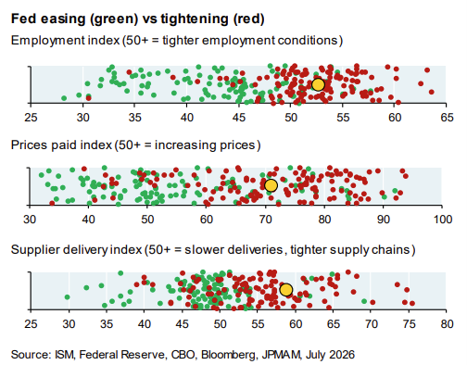
This time is different. In the past, rate hikes affected aggregate demand in the economy—things like mortgages, credit cards, and car loans. The Fed noted that the slack right now isn’t in housing where if anything rates are too high, instead it’s in a different type of real estate: data centers. For the first time tightening is aimed at the supply side in the form of businesses that are using leverage to provide products specifically in the AI stack.
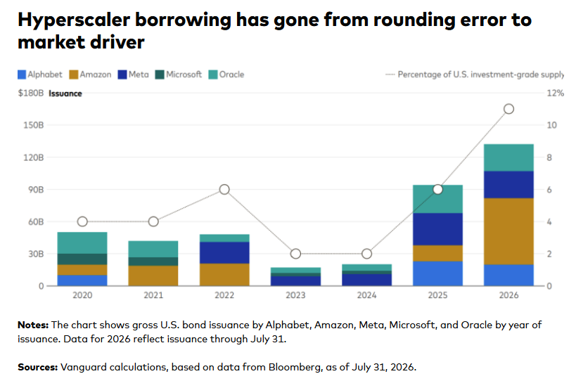
To appreciate the sensitivity to interest rates, we can look at the amount of money slated to be borrowed to build the data centers. Stijn Van Nieuwerburgh, a finance professor at Columbia, calculates that the planned US investments will total 2.80% of GDP out to 2032. To put that in perspective, railroads averaged 2.40% of GDP, electrification 1.10%, the interstate highway system was 1.60%. In short, this is the largest capital expenditure in the history of humankind. Of the 5.5 trillion expected, only about 1.5 is coming from equity. The remainder is slated to be borrowed via the bond market. This scale will occupy 50% of the investment grade bond market. Just as these data centers tap the market, rates are rising. Which raises the question; how high is too high? At what interest rate do data centers become not worth building? Mercatus—an exchange where players can price and trade AI compute capacity in units called tokens—modeled this question by running a single processor cluster at 75% capacity and looked at its cost sensitivity to interest rates. They found that the breakeven was around 11%. Then they looked at the various players and their effective interest rates. You can see in the table below that established software companies (Google, Meta, Amazon, etc.) are in the clear. What’s alarming is that at current rates, late-stage AI companies (like CoreWeave) and venture backed firms are already underwater; and this is before the rate hiking cycle. So, the buildout is being done on credit. You don’t need a Harvard MBA to see how this unstoppable force is about to collide with the immovable object called the bond market.
It’s easy to say laissez faire—let the data centers burn—however, this thesis is the horse on which future US economic growth is saddled. If it doesn’t run, then the entire economy will suffer more than it did when the housing bubble burst. Place that alongside a government that is already at its spending limit and it’s hard to see any entity that can bail this out. I think it’s fair to say that caution is warranted.
So how are we to exercise care and caution as investors? The past five years have delivered gains far exceeding the baseline projections in our financial plans. As I review accounts for our standard fourth-quarter tax-loss harvesting, the process is taking less time each year simply because there are so few losses left to take. As we trim these oversized equity positions back to their target weights, it is worth remembering that if future returns merely revert to our historical plan, we are still winning. The year-over-year numbers may not look quite as eye-popping, but the silent relentless power of compounding remains entirely in our favor. While it is always pleasant to watch account balances grow, four consecutive years of robust equity performance have quietly shifted portfolios into a higher risk bracket. A portfolio carefully calibrated to hold 60% stocks in 2022 has naturally drifted closer to 75% today—which represents a fundamentally different level of risk.
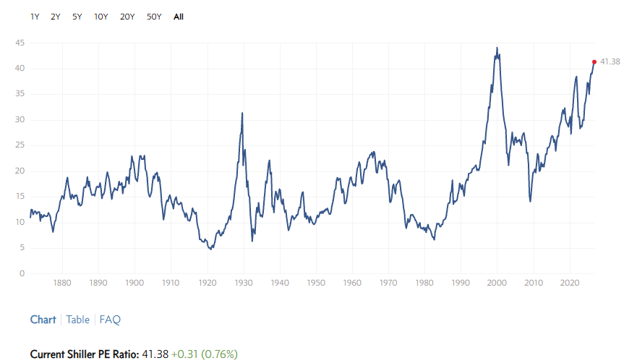
To get a feel for how risky, we can compare stocks to the risk-free rate of interest paid by inflation protected US Treasury bonds (TIPS). This currently stands at about 2.94%. Stocks, which are much riskier, pay you their earnings. If we take all the S&P 500 earnings and divide them by the price using a metric called Shiller’s Adjusted P/E Ratio the result is 41.38. This is the most expensive it has been since 1880 with one brief exception. If we convert this number to a “yield” (1 ÷ 41.38) = 2.42%, investors are betting on even greater corporate profit growth or a dramatic drop in inflation and bond yields.
Camelotta had its 25th birthday last quarter. It’s hard to believe that the kernel of an idea—combining advanced math and investing principles to bear on the real-life financial planning and investing needs of a select clientele—is now mature and still rapidly growing. I am humbled and we could not have done it without a little luck and the continued participation of our dear clients in our success.
Copyright 2026 Camelotta Advisors, All Rights Reserved. The commentary on this website reflects the personal opinions, viewpoints and analyses of the Camelotta Advisors employees providing such comments, and should not be regarded as a description of advisory services provided by Camelotta Advisors or performance returns of any Camelotta Advisors Investments client. The views reflected in the commentary are subject to change at any time without notice. Nothing on this website constitutes investment advice, performance data or any recommendation that any particular security, portfolio of securities, transaction or investment strategy is suitable for any specific person. Any mention of a particular security and related performance data is not a recommendation to buy or sell that security. Camelotta Advisors manages its clients’ accounts using a variety of investment techniques and strategies, which are not necessarily discussed in the commentary. Investments in securities involve the risk of loss. Past performance is no guarantee of future results.
Get in Touch
You can send us an email or schedule a phone call with your team by using the calendar provided here.
Camelotta Advisors is a Registered Investment Adviser. Advisory services are only offered to clients or prospective clients where Camelotta Advisors and its representatives are properly licensed or exempt from licensure. This website is solely for informational purposes. Past performance is no guarantee of future returns. Investing involves risk and possible loss of principal capital. No advice may be rendered by Camelotta Advisors unless a client service agreement is in place.
Enter your text here...