Investor Commentary Q3 2025
Key Takeaways:
- What explains the huge divergence between the economy and the stock market? We see job losses, inflation and negative sentiment juxtaposed against record-setting performances in the S&P 500 and gold only to be exceeded by non-US stocks.
- Bad news is good news: The market climbs a wall of worry constructed out of lower interest rates and higher profitability due to cost cutting (unemployment) and price increases (inflation). The 7 stocks accounting for 40% of the market are focused on AI and, being artificial, is distant from the real economy.
- 2025 held triggers to cash out or bet it all. We took a third path through the haze of uncertainty which involved flexibly responding to the threat of large swings resulting in strong risk adjusted returns.
- Threats from the Executive Branch have brought Fed independence and economic data integrity into question. This at a time of massive deficits could end up in Dollar devaluation.
“Half of investing is mathematics, and the other half is Shakespeare.”
— William J. Bernstein
What would you think if I told you on January 1 that the market was about to correct by 18%, would you have shared the popular impulse to sell to cash? Then, what if I had told you in April that the S&P 500, which had suddenly dropped 18%, would rally 31% to October, would you have taken on a significantly higher amount of risk? The past 2 quarters have been some of the most dramatic and difficult investing conditions in living memory.
It was the best of times, it was the worst of times. How do we square the macroeconomic alarm signals with the record setting returns of global markets? As always, there’s a story: employment, inflation, and sentiment paint a dark picture. During the past year, unemployment increased by almost a full percentage point which historically has not occurred outside of recessions. Labor force growth—a direct input to GDP—shrunk rapidly due to tighter immigration policy. Significantly higher initial and retaliatory tariffs across trading partners are setting inflationary expectations.
The Fed said it well:
Over the longer run, changes in tax, spending, and regulatory policies may also have important implications for economic growth and productivity. There is significant uncertainty about where all of these polices will eventually settle and what their lasting effects on the economy will be.
This narrative around stagnation led the Fed to reduce interest rates for the first time in years and pushed longer-term rates downward which, paradoxically, sparked very positive financial conditions for stocks.
American corporations did well because they were able to raise prices in line with the inflation narrative by 4.60%. Slow hiring helped to cut costs by 6.30%. Consequently, earnings grew by almost 11%.
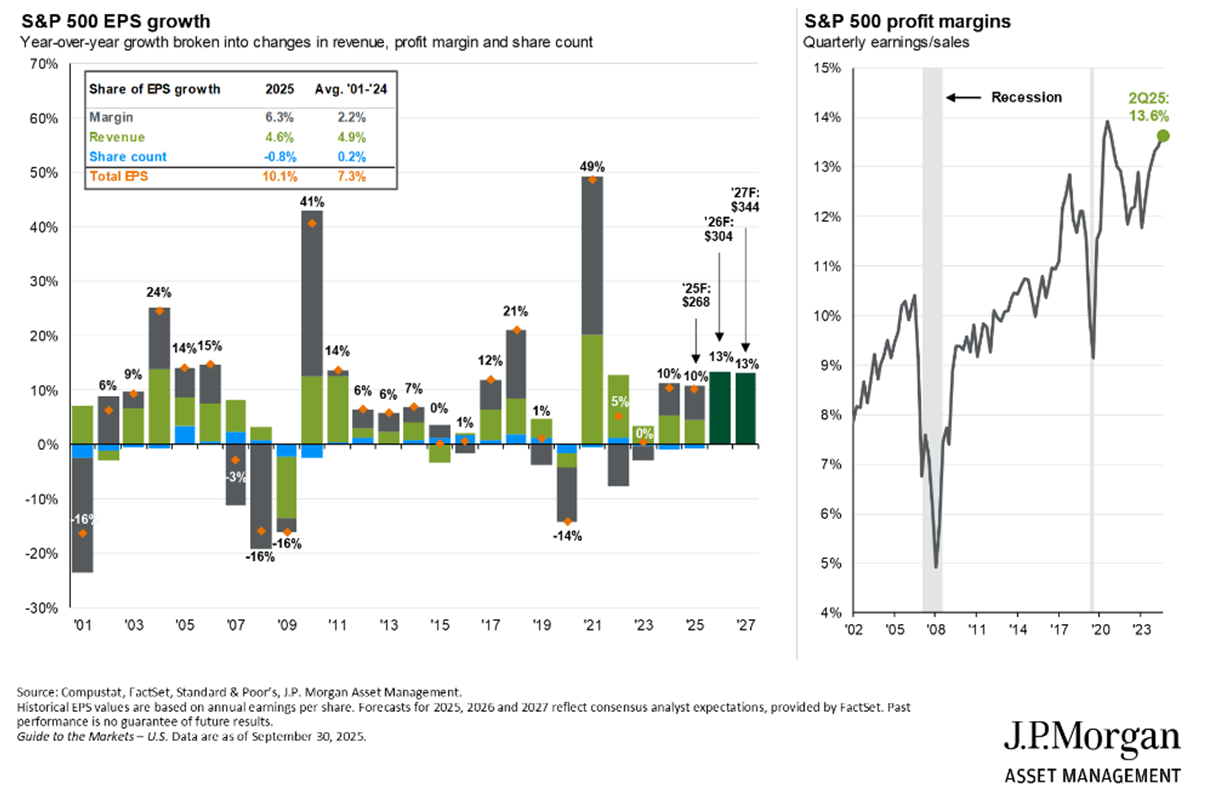
Fig1: Strong adrenaline for the Bulls
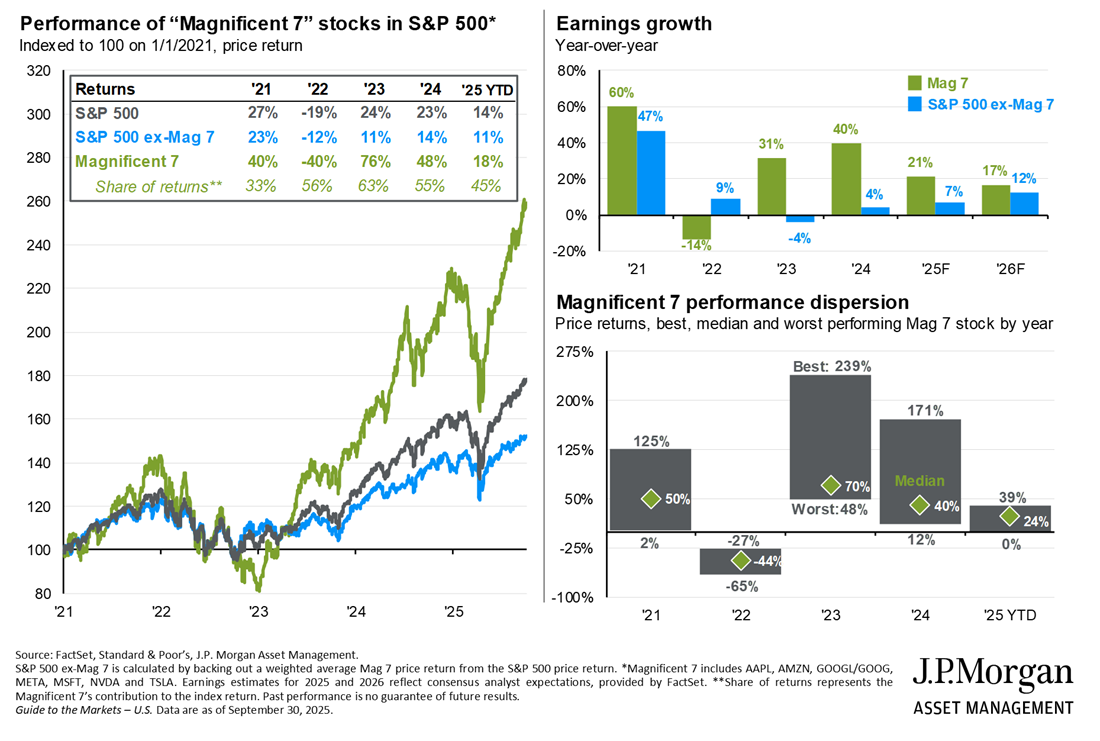
Multiply those earnings by an ever-expanding price earnings ratio and we get an S&P 500 achieving record levels last quarter. Another way in which the market does not reflect the economy: a mere 7 technology stocks boast earnings growth triple that of the other 493 companies! This group’s economic performance hinges on their investments in AI which is, well, not real! These “magnificent 7” stocks explain 45% of the market’s gains.
One of the more hated rallies: sentiment couldn’t be lower. However, “markets climb a wall of worry”—even poor sentiment is a bullish condition!
If you thought this year’s move in the S&P 500 was remarkable, look at our diversifiers. Micro caps were up 15%, our international stocks have risen about 30% and our gold holdings have paid off with a return of 47% this year.
We are blessed that we are in the 10% that enjoy 93% of the market’s value. The other 90% of Americans are not seeing the rise of 6-10% in their incomes which we have seen, while witnessing a frozen labor market, slowing auto and home sales, and inflationary price pressures.
So, where do we go from here? I’m concerned about fragility in the system from two sources. First, divergence between the market (and those of us who participate) and the rest of the economy has become a political issue, leading the Executive Branch to attempt to capitalize on situations that could disrupt markets. Second, I wonder how the trillions of dollars crammed into the AI trade are going to show economic returns above that of the lowest and much less risky yield on Treasuries.
In my NBC Bay Area appearances, I’ve been asked two important questions:
- What if the Executive branch tampers with economic data?
- What happens if the Fed loses their independence?
We had a shocking jobs report revising the data to show that, for most of this year, there were not enough jobs created to absorb the number of individuals entering the labor market from college graduates to recent émigrés. Why do revisions like this occur? It is not a math error, the US government employes some of the world’s best statisticians. The problem is that they are using 20th century tools in a 21st century society. For example, when they survey businesses, large corporations tend to have electronic connections to the data so they submit in a timely manner. But most of the job changes occur at smaller businesses which are less automated. Imagine your favorite restaurant needing to manually complete a BLS survey—perhaps not their top priority. Consequently, they have to use an estimate of these numbers based on the prior numbers. Here’s where things can look incorrect, given that small businesses are the first to fire and last to hire while also being slow to report, changes in economic direction deviate markedly from these estimates. The figures are eventually corrected but at turning points the differences could be dramatic.
Not a perfect system but if we tamper with it, we raise the likelihood of a policy error especially when it comes to determining the amount of money that should be in the economy. Perhaps that’s why Fed Chair Jerome Powell said that there is no path forward that is without risks.
To geek out a bit on interest rates: a solid guideline for Fed Funds is about 1% above the inflation rate. With inflation at 2.75%, the current target of 3.75% seems about right. But there is huge pressure from the White House to ease to a level where there is more money than needed in the economy. The last time we saw loose money against budget deficits was the late ‘60’s—policymakers were too late to respond to the corresponding inflationary pressures. The consequence: the dollar fell so fast that the US was forced to leave the gold standard. Continued pressure to ease comes via “jawboning” rhetoric and attempts to replace Fed governors with members of the executive branch, might succeed. If they do, we would likely see the consequences similar to the late 60’s when there was a steady decline in the value of the US Dollar. This is one of the reasons we continue to invest in gold and international stocks and bonds—as the Dollar depreciates, they rise in Dollar terms.
At the time of this writing, we’re witnessing yet another government shutdown. It’s hard to believe that the US existed for 200 years before the first one, and now they have become routine. It is not about the budget: the debt ceiling is simply a question of whether we pay the bills for goods and services we have already purchased. Let’s hope the partisan wrangling does not end up costing investors.
The erosion of unity, politics notwithstanding, leads me to worry about a fragile, indebted, dysfunctional system unable to respond effectively in the face of a financial crisis.
Investing in these times takes courage. More than ever, investors must take smart risks and size them correctly. We continue to soldier on using our best efforts and care to grow our clients’ wealth through challenging times.
Copyright 2025 Camelotta Advisors, All Rights Reserved. The commentary on this website reflects the personal opinions, viewpoints and analyses of the Camelotta Advisors employees providing such comments, and should not be regarded as a description of advisory services provided by Camelotta Advisors or performance returns of any Camelotta Advisors Investments client. The views reflected in the commentary are subject to change at any time without notice. Nothing on this website constitutes investment advice, performance data or any recommendation that any particular security, portfolio of securities, transaction or investment strategy is suitable for any specific person. Any mention of a particular security and related performance data is not a recommendation to buy or sell that security. Camelotta Advisors manages its clients’ accounts using a variety of investment techniques and strategies, which are not necessarily discussed in the commentary. Investments in securities involve the risk of loss. Past performance is no guarantee of future results.
Get in Touch
You can send us an email or schedule a phone call with your team by using the calendar provided here.
Camelotta Advisors is a Registered Investment Adviser. Advisory services are only offered to clients or prospective clients where Camelotta Advisors and its representatives are properly licensed or exempt from licensure. This website is solely for informational purposes. Past performance is no guarantee of future returns. Investing involves risk and possible loss of principal capital. No advice may be rendered by Camelotta Advisors unless a client service agreement is in place.
Enter your text here...