Investor Commentary Q2 2026
Key Takeaways:
- AI continues to drive markets, but current valuations may be difficult to justify over the long term.
- Rising interest rates remain the primary risk to markets, making diversification and disciplined portfolio management more important than ever.
- Our focus remains on preserving recent gains while positioning portfolios for sustainable long-term growth.
As Q2 goes, so goes 2026. After a lackluster Q1 we experienced a war, the first big AI IPO, a Presidential Summit with China, a new Fed Chair, we all learned to find the Strait of Hormuz on a map, and almost all the stock market gains for 2026. Although the war appears to be on final approach, there are lingering economic effects.
Future historians will say that we live in extraordinary times. When asked if AI is a bubble, I say yes and no. Investors seem to be willing to pay too high a price to get in, leading to the largest infrastructure outlay in the history of the world. There is always a public good aspect to infrastructure spending which will benefit future generations. It is likely that they will reap a greater share of the returns than today’s investors.
When our kids look back on 2026, they will read the SpaceX IPO filing as one of the defining documents of our times. Will they see it as a foundational manifesto heralding a new level of consciousness with Grok winning the AI race? Or will they file it alongside tales of other bubbles: South Sea, Railroads, Dotcom, and Telecom? If you want evidence that we are in a financial bubble, just look at the SpaceX price to revenue ratio of 100, which I discussed in the video I sent you a couple of weeks ago. The company will need to show rapid growth in a very short time frame to justify that valuation. If not, could that be the spark that ends up burning down the house? There are numerous ways in which a collapse in the AI edifice could be widespread and harmful to the global economy. This was highlighted by the Bank for International Settlements (BIS) in its annual economic report, as it laid out the risks of the “current AI exuberance:”
Disappointment in returns could trigger a sudden pullback in financing and turn the capex [capital expenditure] boom into a protracted investment bust, with potential knock-on effects on financial conditions,”
But it said that historical episodes of investment booms provide “instructive parallels” — among them the expansion of canals in the 1830s, railways in Britain in the 1840s and the dotcom boom of the late 1990s.
These all had one key feature in common, said the BIS: “a genuine technological breakthrough that attracted capital in excess of what commercial returns could ultimately justify.”
It added: “These episodes ended with an eventual reversal in investment, inducing economy-wide recessions.”
BIS Annual Economic Report 2026, June28, 2026.
The ramp for AI is long. I was astonished to learn that the best projections of the returns to AI have it adding a mere 0.50% to GDP growth in total over the next decade! The big payoffs are 20 or 30 years beyond that. Capitalism thrives on creative destruction and it’s unclear which of the companies that lead will even exist in over 30 years.
The winning player might be the one who buys this infrastructure at bargain prices, enabling them to realize its paradigm shifting promise of utility. We need look no further than telecom to see an example. Huge amounts of fiber optic cable was deployed at massive expense to shareholders. Almost all of those companies went bankrupt. I have a friend who made $100 million off telecom but subsequently lost $80 million. If you woke up tomorrow with an additional $20 million in your portfolio, you’d be happy but as we know, losses hurt more and the entire experience ended up being traumatic for her. However, in the wake of the telecom bust, we got Spotify, Netflix, and YouTube. These would have been impossible without the investments in bandwidth we saw in that era. What’s troubling is that those returns did not accrue to investors who laid out the initial capital.
How should we approach this conundrum as investors? Let us step back and observe two realities:
A bubble is consensus and each actor believes they can get out before it bursts. Until the music stops, they keep dancing. But how will you know when it’s going to stop ex-ante? When do you get off the train to enjoy the gains we’ve made without giving all of them back?
There is a phenomenon where the AI companies’ investment in one another creates circular financing. However, this is a distraction from the more important consensus that it will be a “winner take all” game leaving second place and below with failed investments. This town’s too small for the Magnificent 7, they are in completely different lines of business—how much of what Amazon resembles NVIDIA? However, they all have focused on one future around AI. The fever behind their investments and complete abandonment of their original business model (I’m looking at you Google), indicates the extent to which there can be only one company on top. So how do we pick the winner?
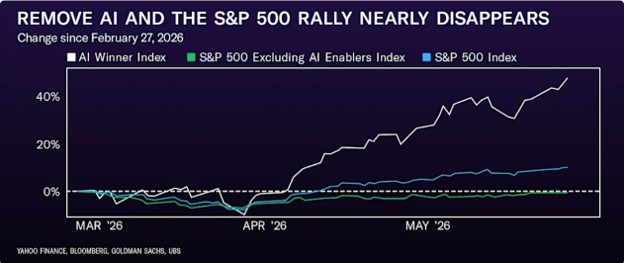
Obviously, we need to be long-term oriented but that’s not enough. Simply owning the S&P 500 has enabled you to benefit from a massive run-up in AI stocks. In fact, if you subtract JP Morgan’s list of the 41 AI-related companies from the recent S&P 500 rally, the remaining 459 stocks were flat. Imagine what we’d be talking about if the S&P 500 had only returned 0% this quarter?
I’ve written in these pages before about the K shaped economy and how 70% of the US GDP is consumer spending. Of that spending, the lion’s share is the upper crust—among them, Camelotta clients—who are able to own and participate in the financial markets. It’s easy for us to be complacent and forget that the norm for most in the economy looks flat or worse if we inflation adjust it—the downward leg of the K. If the AI trade fizzles out or slows down, then you might see this elite consumer group pull back on spending which would have a major impact on US and global economic growth.
We want a horse in the race, but we also don’t want to have only one way to make money. Our response is not to abandon innovation or attempt to call a market top. Instead, we are broadening portfolio exposure, reducing concentration risk where valuations have become extreme, and maintaining the flexibility to participate in future opportunities without becoming dependent on a single investment thesis.
Last quarter our international holdings performed just as well as the S&P 500. I see more potential for future profits in terms of the cheapness of the companies (compare their price to revenue multiple of 2 to SpaceX at 100), the types of businesses, and the continual weakening of the dollar. You may have noticed how popular Japan has become as a vacation destination. This is because the Yen is the weakest it has been since 1986. Given that they have one of the most severe baby shortages in the world, they have swaths of unoccupied housing. All of this means you will likely start hearing about people moving to Japan as a retirement plan!
The biggest threat to the current success of stocks is the specter of higher interest rates. The new Fed chair indicated that they are biasing more towards raising rates before the end of the year. In addition, there is weak demand for US Treasuries. During Covid, the US budget deficit ballooned more rapidly than ever before. To finance it, the Treasury borrowed enormous amounts in short duration bonds. Interest on the debt balance is now the largest expense paid by the US government; more than defense. The Covid bonds are coming due and, rather than pay them off, the US intends to refinance them with more bonds. Anyone who refinanced a house during 2021/2022 knows that the interest rates available then are impossible to obtain now. Tariffs, sanctions, and protectionism have led foreign governments to store funds in other currencies. The petrodollar agreement no longer exists; to entice buyers, new bonds will need to offer much higher interest rates. It’s sobering to imagine the tax rate it would take to compensate for the higher cost to refinance this debt.
Adding to the pressure, the Iran war could also raise rates. There are countries locked behind the Strait of Hormuz who have not been able to ship oil and gas. Still other consumers of hydrocarbons are paying higher prices and dip into savings to buy it. These savings are held in US Treasuries and what oil producers and consumers have in common is a need to sell US Treasury bonds for Dollars and when bond prices go down due to selling, the interest rates to reissue the bonds go higher.
The first domino to fall was the United Arab Emirates. Rather than deal with the interest rate spike from a major central bank selling US treasuries, the US extended a swap line enabling them to borrow Dollars in lieu of selling bonds. This instance alone is fine however it sets a precedent. Qatar is next in a line of countries asking for the same credit facility. In doing so the US government itself is essentially borrowing to extend these dollars to them.
Who can we find to purchase US Treasuries? This market is giant: 10 times larger than the stock market. This leaves one major pool of money large enough to make an impact: Chinese savers - they have a large savings glut caused by a collapse in their real estate market a medical system that is problematic and has strained local budgets. The problem facing a Chinese saver is that they have limited real estate investment options and, moreover, there is a legitimate risk of capital confiscation. Therefore, many would love to push their money outside of the country however it is illegal to transfer more than about $50,000 per year outside of China.
Trump made a very strange and hastily put together trip to China during Q2. Not only that, but he also took some of the most prominent American business leaders with him. This was not simply to demonstrate American financial success, but rather to solicit these Chinese investors to put money into the United States. You might ask, how can they do that if it is illegal? Well, the answer is a new financial construct called Stablecoin. These are like Bitcoin with the added feature that they are backed by US Treasuries.
The Chinese government seems to be looking the other way when residents purchase stablecoins. If this remains true, then, in theory we have a mechanism linking Chinese savings to the US Treasury market. It’s no coincidence that they recently passed the law in the United States that a major stablecoin offerings must be secured with US Treasury bonds.
The upshot is that we need to keep an eye on the oil price. As this crisis wanes and oil prices drop, the pressure on US Treasuries should ease. However, if oil sticks at high levels and countries continue to have trouble funding their fuel budgets then you could see increasing pressure on the bond market. This could pose a serious risk similar to 2022 where all assets sold off—the worst market in a century for asset allocators. I would say that this is a tail case and it’s not likely to become a major issue. Outside of this, we will increasingly hear stories about this Treasury funding failure and the efforts by the US government to fix it. We have a very workable game plan, should this play out.
Copyright 2026 Camelotta Advisors, All Rights Reserved. The commentary on this website reflects the personal opinions, viewpoints and analyses of the Camelotta Advisors employees providing such comments, and should not be regarded as a description of advisory services provided by Camelotta Advisors or performance returns of any Camelotta Advisors Investments client. The views reflected in the commentary are subject to change at any time without notice. Nothing on this website constitutes investment advice, performance data or any recommendation that any particular security, portfolio of securities, transaction or investment strategy is suitable for any specific person. Any mention of a particular security and related performance data is not a recommendation to buy or sell that security. Camelotta Advisors manages its clients’ accounts using a variety of investment techniques and strategies, which are not necessarily discussed in the commentary. Investments in securities involve the risk of loss. Past performance is no guarantee of future results.
Get in Touch
You can send us an email or schedule a phone call with your team by using the calendar provided here.
Camelotta Advisors is a Registered Investment Adviser. Advisory services are only offered to clients or prospective clients where Camelotta Advisors and its representatives are properly licensed or exempt from licensure. This website is solely for informational purposes. Past performance is no guarantee of future returns. Investing involves risk and possible loss of principal capital. No advice may be rendered by Camelotta Advisors unless a client service agreement is in place.
Enter your text here...